I have never been especially interested in what happens to people. What holds me is what they decide to carry afterward, and what they quietly set down instead, never once admitting they had been carrying it at all.
I write about people caught between love and duty, and about the histories they didn't choose but have to live inside anyway. Sometimes that history belongs to a city that existed a century ago. Sometimes it hasn't happened yet. Sometimes it's just two people in the same house, working out what they actually mean to each other, with no war and no empire to hide behind.
What interests me isn't the event itself. It's the betrayal, the inheritance, the decision made at twenty that a person is still paying for at sixty. Underneath all of it is a kind of arithmetic. What a life costs. Who ends up paying. How rarely those turn out to be the same person.
That question doesn't stay inside one genre for long. It's why my work moves between periods and forms rather than settling into one. The century changes. The question underneath it mostly doesn't.

Debut Novel
Blackwood Street
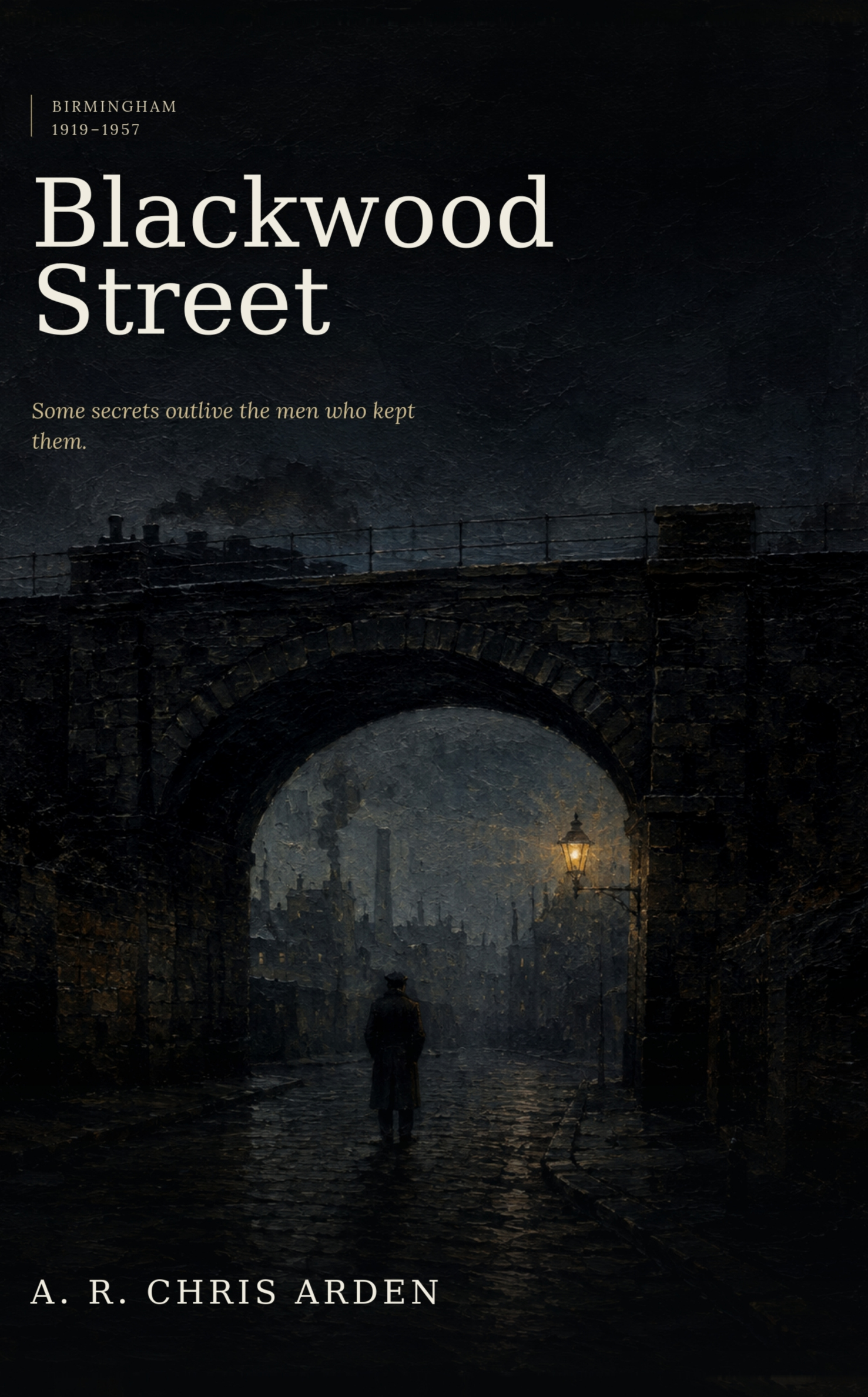
Some debts don't stay with the man who incurred them.
Birmingham, 1919 to 1957. A man decides, quietly and only once, that he will never again be powerless. He spends the rest of his life building the proof of it, one debt at a time, one favour at a time, one silence at a time. What he leaves behind isn't a fortune so much as an inheritance of things unsaid, and a son who has to work out, piece by piece, exactly what he's agreed to by staying.
This is a book about the ledger a family keeps without ever writing it down, and what it costs to finally read it.
Read About the Book →In Progress
An Untitled War Novel
Set in an American training camp during the Second World War, this is a novel about the friendships men make when they have no idea how long they'll be allowed to keep them. It isn't really a war story. It's a story about waiting for one, about the ordinary hours before the ones history remembers, and what people do with each other inside that waiting.
The outline is finished. Several chapters are written. The rest is still being earned, one draft at a time.
The Work Ahead
Not everything is ready to be read yet
Some of it is already taking shape. Some of it is a single sentence in a notebook, waiting for the rest of itself to arrive.
People I already know completely, still waiting on the one ending that will let them go.
A beginning and a middle, written far enough in that stopping now would cost more than finishing.
A page of notes, and a feeling about someone I haven't met yet that refuses to leave.
The slow ones. The kind of book you don't rush because you only get to write it once.
On the Novel
What I think a novel is for
A novel doesn't have to tell you what happened. That's what history is for. What a novel can do, better than almost anything else, is make you remember how it felt.
I'm interested in memory more than event: the version of a story a person keeps for themselves, which is rarely the version anyone else would tell. I'm interested in the choices people make once and then spend decades quietly living inside. A marriage. A silence. A debt taken on at twenty that has become, by sixty, the whole shape of a life. I'm interested in what love actually asks of people, as opposed to what it promises them.
None of this requires a lesson at the end. I'm not trying to tell anyone what to think about grief, or loyalty, or the things families don't say to each other. I just want the reader to close the book still feeling it, the way a room stays warm after everyone's left it.
About
Before the books, the questions
Short version
A. R. Chris Arden writes historical and literary fiction about the debts families carry without naming them. Blackwood Street, his debut, is set in Birmingham between the wars.
What the longer version covers
Why the work refuses to sit inside one genre. What keeps pulling him back to inheritance, silence, and the price of loving someone completely. And how a first novel, after several false starts, finally became one.
Read the Full Essay →Publishers & Agents
For professional enquiries
Blackwood Street is complete and available for review by literary agents, publishers, editors, and rights professionals. Enquiries of the following kind are welcome:
- Manuscript requests, full or partial
- Publishing and territorial rights
- Translation rights
- Audiobook rights
- Film and television adaptation rights
Rights availability can be discussed upon enquiry.
Author / Publisher Information Pack
A single document covering the manuscript, synopsis, author biography, and contact details for professional use.
Request the PackPress / Media
For journalists and interview requests
Available
Author photograph, short and full biography, and book information, all available on request for editorial use.
Interviews
Interview requests, written or recorded, can be sent directly and will receive a personal reply.
Contact
Press enquiries: hello@ardenwrites.com
Get In Touch
Let's talk.
Different kinds of enquiries go to different kinds of conversations. Pick the one that fits.